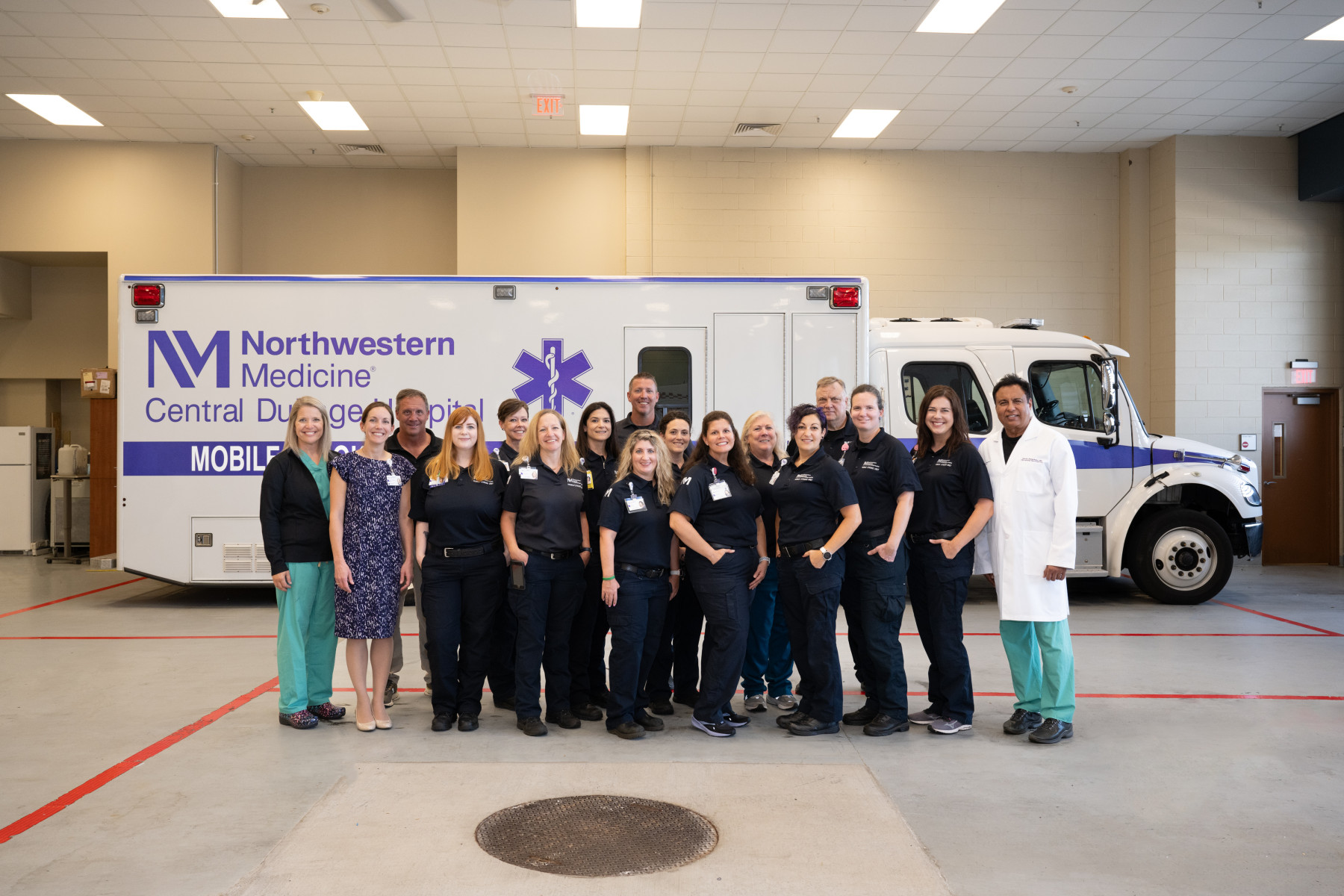
Northwestern Medicine and the South Elgin and Countryside Fire Protection District are collaborating to offer life-saving stroke diagnosis and treatment to residents of the South Elgin area and the northwestern suburb. Northwestern Medicine’s Mobile Stroke Unit (MSU) can now be dispatched to essentially create an emergency room in a parking lot, saving precious minutes.
The first of its kind in Illinois, Northwestern Medicine’s MSU has a 16-slice CT scanner, telemedicine connections and stroke-specific medications. The team is comprised of a critical care nurse, a CT technician, an EMT technician driver, and a critical care paramedic.
 For patients who meet stroke criteria, the South Elgin and Countryside Fire Protection District can request the MSU meet their ambulance at a location between South Elgin and Central DuPage Hospital in Winfield. The patient is transferred into the MSU for a CT scan, telemedicine assessment by a stroke neurologist, and treatment. The patient is then transported to Central DuPage Hospital often as a direct admit bypassing the emergency department.
On average, Northwestern Medicine’s Mobile Stroke Unit provides life-saving treatment 30 minutes faster than traditional transport.
“We are getting a 30-minute head start by bringing the emergency room to the patient,” said Harish Shownkeen, MD, medical director of the Stroke and Neurointerventional Surgery Programs at Northwestern Medicine Central DuPage Hospital. “The earlier you treat the patient the better their outcome. Patients who get treated right away often go home from the hospital instead of to a nursing home or rehabilitation.”
Stroke is the fifth leading cause of death in Illinois and the leading cause of serious long- term disability according to the Centers for Disease Control.
“This unit brings the treatment to the patient, providing a direct connection with a neurologist who can identify and confirm or deny if a patient is experiencing a stroke. Crews can administer the correct medicine when applicable which can drastically reduce the amount of damage occurring to the brain every second as a result of a stroke,” said Fire Chief William Luchsinger, South Elgin and Countryside Fire Protection District.
The South Elgin and Countryside Fire Protection District and Northwestern Medicine want to remind patients that if you suspect someone is having a stroke, remember BE F.A.S.T.:
B: Balance- Is the person suddenly having trouble with balance or coordination?
E: Eyes. Is the person experiencing suddenly blurred or double vision or a sudden loss of vision in one or both eyes without pain?
F: Facial droop
A: Arm Weakness on one side
S: Speech Difficulty
T: Time to call 911
Northwestern Medicine Central DuPage Hospital has earned the Advanced Comprehensive Stroke Center designation by The Joint Commission. The highest level of stroke certification, this designation recognizes the significant resources in staff, training and state-of-the-art infrastructure that comprehensive stroke centers must have to treat complex cases.
Northwestern Medicine Central DuPage Hospital’s Mobile Stroke Unit can be directly dispatched by 9-1-1 to patients within the hospital’s Emergency Medical Services (EMS) area, which includes Carol Stream, Bartlett, Glen Ellyn, Glenside, Hanover Park, Roselle, Warrenville, West Chicago, Wheaton and Winfield. For areas in the secondary region that includes St. Charles, Geneva, Batavia, Elburn, Big Rock, Sugar Grove, South Elgin, North Aurora and Fox River/Countryside, fire protection districts and ambulance services can request the MSU for patients who meet stroke criteria.
Northwestern Medicine y South Elgin and Countryside Fire Protection District están colaborando para ofrecer diagnóstico y tratamiento de accidentes cerebrovasculares que salvan vidas a los residentes del área de South Elgin y el suburbio del noroeste. La Unidad Móvil de Accidentes Cerebrovasculares (MSU) de Northwestern Medicine ahora se puede enviar para crear esencialmente una sala de emergencias en un estacionamiento, ahorrando valiosos minutos.
La MSU de Northwestern Medicine, la primera de su tipo en Illinois, tiene un escáner CT de 16 cortes, conexiones de telemedicina y medicamentos específicos para accidentes cerebrovasculares. El equipo está compuesto por una enfermera de cuidados intensivos, un técnico de tomografía computarizada, un conductor técnico de EMT y un paramédico de cuidados intensivos.
Para los pacientes que cumplen con los criterios de accidente cerebrovascular, el Distrito de Protección contra Incendios de South Elgin y Countryside puede solicitar que la MSU encuentre su ambulancia en un lugar entre South Elgin y Central DuPage Hospital en Winfield. El paciente es trasladado a la MSU para una tomografía computarizada, una evaluación de telemedicina por parte de un neurólogo especializado en accidentes cerebrovasculares y un tratamiento. Luego, el paciente es transportado al Central DuPage Hospital, a menudo como ingreso directo sin pasar por el departamento de emergencias.
En promedio, la Unidad Móvil de Accidentes Cerebrovasculares de Northwestern Medicine brinda tratamientos que salvan vidas 30 minutos más rápido que el transporte tradicional.
“Estamos obteniendo una ventaja de 30 minutos al acercar la sala de emergencias al paciente”, dijo Harish Shownkeen, MD, director médico de los Programas de Accidentes Cerebrovasculares y Cirugía Neurointervencionista del Hospital Central DuPage de Northwestern Medicine. “Cuanto antes se trate al paciente, mejores serán sus resultados. Los pacientes que reciben tratamiento de inmediato a menudo regresan a casa desde el hospital en lugar de ir a un asilo de ancianos o a rehabilitación”.
El accidente cerebrovascular es la quinta causa principal de muerte en Illinois y la principal causa de discapacidad grave a largo plazo según los Centros para el Control de Enfermedades.
“Esta unidad lleva el tratamiento al paciente, proporcionando una conexión directa con un neurólogo que puede identificar y confirmar o negar si un paciente está sufriendo un derrame cerebral. Las cuadrillas pueden administrar el medicamento correcto cuando corresponda, lo que puede reducir drásticamente la cantidad de daño que ocurre en el cerebro cada segundo como resultado de un derrame cerebral”, dijo el Jefe de Bomberos William Luchsinger, Distrito de Protección contra Incendios de South Elgin y Countryside.
El Distrito de Protección contra Incendios de South Elgin y Countryside y Northwestern Medicine quieren recordar a los pacientes que si sospecha que alguien está sufriendo un derrame cerebral, recuerde SEA RÁPIDO:
B: Equilibrio: ¿la persona repentinamente tiene problemas con el equilibrio o la coordinación?
E: Ojos. ¿La persona experimenta repentinamente visión borrosa o doble o pérdida repentina de la visión en uno o ambos ojos sin dolor?
F: caída facial
A: Debilidad del brazo en un lado
S: Dificultad del habla
T: Es hora de llamar al 911
Northwestern Medicine Central DuPage Hospital obtuvo la designación de Centro Integral Avanzado de Accidentes Cerebrovasculares por parte de The Joint Commission. Esta designación, el nivel más alto de certificación de accidentes cerebrovasculares, reconoce los importantes recursos en personal, capacitación e infraestructura de vanguardia que los centros integrales de accidentes cerebrovasculares deben tener para tratar casos complejos.
La Unidad Móvil de Accidentes Cerebrovasculares de Northwestern Medicine Central DuPage Hospital puede enviarse directamente al 9-1-1 a los pacientes dentro del área de Servicios Médicos de Emergencia (EMS) del hospital, que incluye Carol Stream, Bartlett, Glen Ellyn, Glenside, Hanover Park, Roselle, Warrenville, Oeste de Chicago, Wheaton y Winfield. Para áreas en la región secundaria que incluye St. Charles, Geneva, Batavia, Elburn, Big Rock, Sugar Grove, South Elgin, North Aurora y Fox River/Countryside, los distritos de protección contra incendios y los servicios de ambulancia pueden solicitar la MSU para pacientes que cumplen con los requisitos de accidente cerebrovascular. criterios.